

A patient-friendly guide by Dr. Simple Bhadania, ENT & Skull Base Surgeon, Ahmedabad
You had nasal surgery. Your doctor told you it went well. The scans look clear. And yet, breathing still feels wrong.
You feel like you are not getting enough air, even though your nasal passage appears wide open. This experience has a name: Empty Nose Syndrome (ENS).
This article explains what empty nose syndrome is, why it happens, what the symptoms feel like, and what you can do about it.
What Is Empty Nose Syndrome?
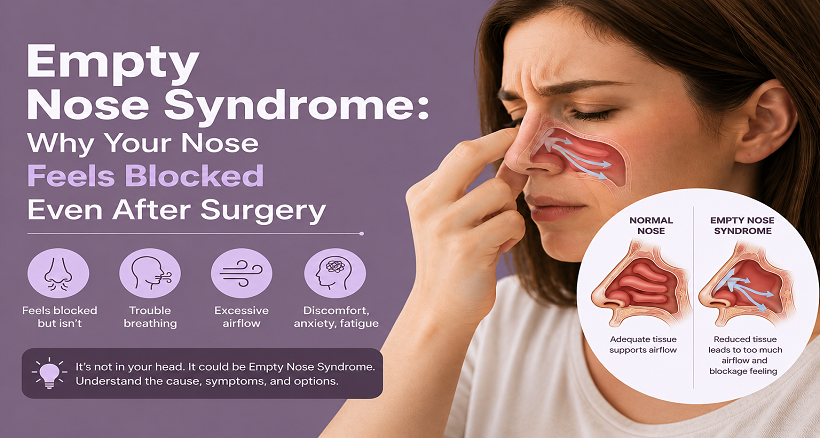
Empty nose syndrome is a condition where a person feels as if they cannot breathe properly through their nose, even though the nasal airway is actually open and clear.
The term was first used in 1994 to describe what doctors saw on CT scans after turbinate surgery: a nasal cavity that looked too empty, too open, with too little tissue left inside.
This is what makes ENS so confusing: the nose looks fine on the outside and even on imaging, but the person feels suffocated, blocked, or short of breath. The problem is not with the size of the airway. It is with the loss of the structures that make breathing feel right.
What Are the Turbinates and Why Do They Matter?
Inside your nose, there are small shelf-like structures called turbinates. You have three pairs of them, on each side of the nasal cavity. They are covered with soft, moist tissue.
The turbinates do three important things for every breath you take:
- They warm the air before it reaches your lungs.
- They add moisture to the air so your airways do not dry out.
- They filter out dust, pollutants, and germs.
- They sense airflow, giving your brain the feeling of a satisfying breath.
When turbinate tissue is removed or reduced too aggressively during surgery, these functions are disrupted. The nose becomes an open space, but it no longer works the way it should.
Empty Nose Syndrome Causes
Empty nose syndrome is caused by the removal or over-reduction of turbinate tissue during nasal surgery. The most common procedures linked to ENS include:
- Turbinate reduction (also called turbinoplasty or turbinectomy)
- Septoplasty, when done alongside aggressive turbinate work
- Other nasal surgeries where too much internal tissue is removed
The key word is over-resection. When more tissue is removed than necessary, the nose loses its ability to regulate airflow. The result is a large, open cavity that cannot humidify, warm, or sense air properly.
Not everyone who has turbinate surgery develops ENS. It is considered a rare complication. But for those who do experience it, the symptoms can be significant and long-lasting.
Is Empty Nose Syndrome Common?
Empty nose syndrome is rare. It affects a small percentage of people who undergo turbinate reduction surgery. Most patients who have turbinate surgery breathe much better afterwards and do not develop ENS.
However, because millions of nasal surgeries are performed each year, even a small percentage means a meaningful number of people are affected worldwide. ENS is likely underdiagnosed because its symptoms can overlap with other conditions, and some doctors may not be familiar with it.
If you have had nasal surgery and your breathing still does not feel right, it is worth speaking with a specialist who understands this condition.
Symptoms of Empty Nose Syndrome
The symptoms of ENS are unusual and often confusing, both for patients and doctors. The nose looks and scans as open, but the person feels the opposite. Common symptoms include:
- A constant feeling of nasal blockage or stuffiness despite open airways
- A sensation of not being able to breathe deeply enough
- Feeling as though air rushes through too fast, without being felt properly
- Dryness inside the nose and throat
- Nasal crusting
- Occasional light bleeding from the nose
- Disturbed sleep or waking up gasping
- Fatigue and difficulty concentrating
- Anxiety or low mood linked to breathing discomfort
These symptoms can affect daily life significantly. The loss of the sensation of breathing can be deeply unsettling and is sometimes described as the feeling of suffocation even while the airway is completely clear.
It is also important to note that ENS can affect mental health. Living with constant breathing discomfort, especially when doctors cannot see an obvious cause, can lead to anxiety and depression. Psychological support is an important part of care for many ENS patients.
How Is Empty Nose Syndrome Diagnosed?
Diagnosing ENS requires a specialist with experience in this condition. There is no single test that confirms it. Diagnosis usually involves:
- A detailed medical history, including past nasal surgeries
- A nasal endoscopy to look inside the nasal cavity
- CT scan imaging to assess tissue loss
- A validated questionnaire called the ENS6Q (a six-item questionnaire designed specifically for this condition)
- The cotton test, where a small piece of moist cotton is placed inside the nasal cavity to mimic the effect of additional tissue; if symptoms improve temporarily, it supports the diagnosis
A thorough evaluation by an experienced ENT surgeon is essential to rule out other causes and confirm the diagnosis.
Empty Nose Syndrome Treatment
There is no single cure for ENS, but there are several approaches that can reduce symptoms and improve quality of life. Treatment is usually personalised based on the severity of symptoms and the extent of tissue loss.
Conservative (Non-Surgical) Options
- Nasal saline rinses and sprays to keep the inside of the nose moist
- Nasal gels and oils to soothe dryness and reduce crusting
- Humidifiers at home and in the workplace
- Breathing through the nose in a slow, controlled way
- Counselling or cognitive behavioural therapy (CBT) to address anxiety and psychological distress related to breathing
- Staying well hydrated and avoiding dry environments
Medical Options
In some cases, medications that help swell nasal tissue slightly can be used to create more sensation of airflow. These are used carefully and under medical supervision.
Surgical Options
When conservative measures are not enough, surgical reconstruction of the nasal interior may be considered. The goal is to restore some of the turbinate bulk so the nose can once again warm, humidify, and sense airflow.
Various materials can be used in reconstructive surgery, including the patient’s own tissue, donor material, or synthetic implants. Research published in 2024 has reviewed multiple surgical approaches and found that many patients report meaningful improvement in symptoms and quality of life after reconstruction.
Surgical options carry their own risks and are not suitable for everyone. The right approach depends on how much tissue was removed, the patient’s overall health, and the surgeon’s expertise.
How to Avoid Empty Nose Syndrome
The best way to avoid empty nose syndrome is to preserve as much turbinate tissue as possible during nasal surgery. This is why the approach and experience of your surgeon matter greatly.
If you are considering turbinate reduction or any nasal surgery, here are some things to keep in mind:
- Ask your surgeon how much turbinate tissue will be removed and why.
- Ask whether a more conservative approach is possible for your situation.
- Discuss the risk of ENS before agreeing to any turbinate procedure.
- Seek a second opinion from an ENT specialist if you are unsure.
Not all turbinate surgeries lead to ENS. When performed conservatively and with care, these procedures are safe and effective for the vast majority of patients. The aim is to find the right balance between opening the airway and preserving the tissue that makes breathing feel natural.
When to See a Specialist
If you have had nasal surgery and are still experiencing breathing discomfort, dryness, or a feeling of not getting enough air through your nose, do not dismiss it.
These symptoms deserve a proper evaluation. ENS is a real condition, and with the right care, many patients do find relief. Early assessment gives you the best chance of finding the most effective treatment for your specific situation.
If you are concerned about your nasal health after surgery, speak with Dr. Simple Bhadania at ACE Neuro ENT Hospital, Ahmedabad. Always discuss your symptoms and treatment options with your surgeon to find the right path for your individual situation.
This article is for informational purposes only and does not replace personalised medical advice. The best approach for any nasal condition always depends on the patient’s specific situation, the surgeon’s expertise, and available facilities. Please discuss with your surgeon before making any decisions about treatment.