

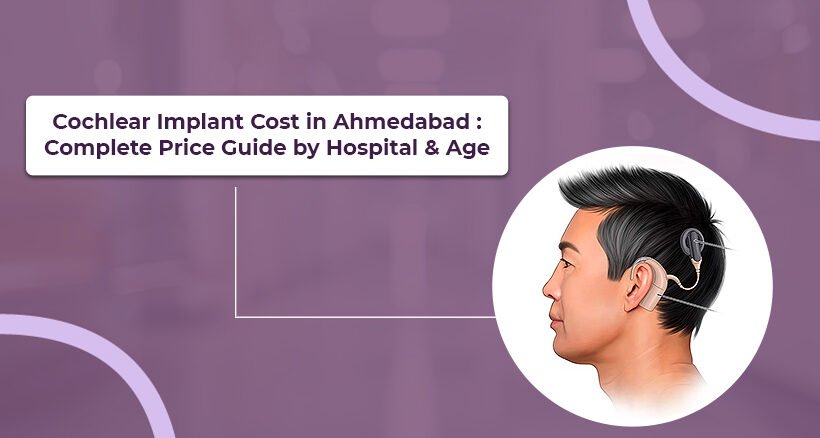
If you’ve started researching cochlear implants for your child, a parent, or yourself, you’ve probably already noticed the problem: every website seems to quote a different number. That’s not because anyone is hiding something. Cochlear implant cost genuinely varies from patient to patient, based on the device, the surgery, the hospital, and the rehabilitation that follows.
This guide breaks down what actually goes into that final number, what most people don’t budget for, and how planning differs by age so that when you do sit down with an ENT specialist, you’re asking the right questions instead of guessing.
Key Takeaways
- Cochlear implant cost in Ahmedabad broadly falls in the range of roughly ₹4–9 lakh for the device and surgery, based on aggregated market data actual pricing depends on the hospital, device brand, and whether one or both ears are implanted.
- Unilateral (one ear) implants sit at the lower end of the range; bilateral (both ears) costs meaningfully more but is often recommended for young children for better sound localisation.
- The quoted “surgery cost” is rarely the full picture; pre-op tests, device mapping sessions, and ongoing auditory-verbal therapy are usually billed separately and add up over the following 1–3 years.
- Age affects candidacy and outcomes, not just planning; early evaluation matters most for infants and young children, where the window for spoken-language development is considered most favourable.
- There is no single universal “success rate” for cochlear implants; outcomes depend on age at implantation, duration of hearing loss beforehand, and consistency with rehabilitation therapy.
- Always ask for a written, itemised estimate after your evaluation rather than relying on a quoted starting price.
Cochlear Implant Cost in Ahmedabad
Here’s the honest answer: there is no single fixed price for a cochlear implant in Ahmedabad, and any website that gives you one exact number without knowing your case is oversimplifying it.
Based on aggregated market data across Ahmedabad hospitals, private cochlear implant surgery (device plus procedure) is broadly reported in the range of roughly ₹4 lakh to ₹9 lakh, with many cases falling closer to the ₹5–7 lakh mark. This is a general market indicator, not a quote for actual pricing at any specific hospital, including ACE Neuro ENT Hospital, depends on the device brand selected, whether one or both ears are being implanted, the surgical complexity, and what the package includes.
The most reliable way to know your actual cost is to get a written, itemised estimate after your evaluation, one that clearly states what’s included (device, surgery, hospital stay) and what’s billed separately (pre-op tests, mapping, therapy).
Indicative Cost Breakdown by Component
(General market indicators for Ahmedabad, not a quote from any specific hospital)
Device + Surgery (Unilateral) roughly ₹4 lakh – ₹9 lakh, varying by device brand and hospital
Pre-operative Evaluation (audiometry, imaging, medical work-up) billed separately, typically a smaller fraction of the total
Mapping / Activation Sessions (first year, multiple visits) billed per session or as a bundled package by some hospitals
Auditory-Verbal Rehabilitation (ongoing, especially for children) usually an ongoing monthly cost over 1–3 years, separate from the surgery bill
The final total depends on the device selected, whether one or both ears are implanted, and how the hospital structures its package; always confirm exactly what’s included before comparing quotes.
Cochlear Implant Cost in Ahmedabad by Procedure Type
The “type” of cochlear implant procedure has a bigger effect on total cost than almost anything else:
Complex or revision cases: Cases involving unusual inner-ear anatomy, prior ear surgery, or re-implantation after device failure typically involve more surgical time and cost more than a straightforward first-time implant.
Unilateral implant (one ear): The standard starting point for most patients is generally the lower end of the cost range.
Bilateral implant (both ears): Two devices and two surgical sites, so the cost is meaningfully higher, though many surgeons recommend it particularly for young children because it improves sound localisation and hearing in noisy environments.
Device brand and technology tier: Cochlear implant manufacturers offer different processor generations and features (like better speech-in-noise processing or connectivity), which affect device pricing independent of the surgery itself.
Hidden or Additional Costs to Plan For
This is the part most searches for “cochlear implant cost” miss, and it’s arguably more important than the headline surgery number, because it’s genuinely easy to underestimate.
- Pre-operative diagnostics: audiometry, imaging, blood work, and anaesthesia fitness tests
- Hospital charges: room category, OT charges, and anaesthesia fees, which vary by hospital type
- Medicines and post-op care during the hospital stay and immediately after
- Device activation and mapping sessions: the processor is switched on and programmed a few weeks after surgery, and needs several follow-up mapping visits in the first year
- Auditory-verbal rehabilitation for children in particular, structured listening and speech therapy over months to years is what actually turns “hearing” into “understanding speech,” and this is usually billed separately, often on an ongoing basis
- Batteries, accessories, and processor maintenance small but recurring costs over the years
- Eventual processor upgrades: the internal implant is built to last, but external speech processors are typically replaced or upgraded after several years of use
Risks and Possible Complications
As with any surgery, cochlear implantation carries some risk, though serious complications are uncommon. Possible issues include the usual surgical risks (infection, bleeding, anaesthesia-related risks), temporary dizziness or taste changes, and device-related issues such as electrode migration or, rarely, device failure requiring revision surgery. Your surgeon will walk you through the specific risk profile for your case during counselling this isn’t meant to alarm you, just to make sure you’re deciding with full information.
Benefits of Early Evaluation
Whatever the eventual decision, getting evaluated early rather than waiting tends to work in the patient’s favour:
- For infants and young children, earlier identification of hearing loss (through newborn screening, OAE, or BERA) means more time for spoken-language development if an implant is recommended
- Earlier evaluation gives families more time to plan financially, including exploring any applicable government or insurance support, before surgery becomes urgent
- Trying hearing aids first, where appropriate, and moving to implant evaluation without long delays avoids losing valuable time during a child’s early developmental window
- For adults, earlier evaluation after significant hearing loss generally means the brain has had less time to “forget” how to process spoken sound, which can support faster adaptation after implantation
- An early, unhurried evaluation gives the family time to ask questions and understand the rehabilitation commitment, rather than deciding under pressure
When Should You Consult an ENT Specialist?
If hearing aids aren’t giving enough benefit, if a newborn hearing screening has flagged a concern, or if you simply want a clear, honest assessment of whether a cochlear implant is worth considering for your situation, that’s the right time to see a specialist.
Dr. Simple Bhadania is an ENT specialist in Ahmedabad with a specific focus on cochlear implant evaluation and surgery, alongside her broader Neuro-ENT and skull-base training. As an ear specialist doctor in Ahmedabad, she works through the full picture with patients and families: hearing evaluation, candidacy assessment, the surgery itself, and what rehabilitation will realistically involve rather than just the price of the operation.
Conclusion
Cochlear implant cost in Ahmedabad isn’t a single fixed number; it depends on the device, whether one or both ears are implanted, the hospital, and the rehabilitation plan that follows surgery. The figure quoted for the surgery itself is only part of the real total; mapping sessions and auditory-verbal therapy in the years after implantation matter just as much for the outcome as the procedure does. What matters most isn’t finding the lowest quoted price; it’s getting an accurate, individualised evaluation from an experienced ENT specialist, since that’s what actually determines whether a cochlear implant is the right option, and what it will realistically cost for your specific case.
Cochlear Implant Care in Ahmedabad
If you’re exploring cochlear implants for yourself or a family member and want a clear, honest evaluation along with a realistic, itemised cost estimate, consult Dr. Simple Bhadania
Frequently Asked Questions
Is a cochlear implant a risky surgery?
No it’s a well-established procedure with a low complication rate. Like any surgery under anaesthesia, it carries some risk, but it’s not considered high-risk. Your surgeon will review your specific risk factors beforehand.
How much does a single cochlear implant cost?
Roughly ₹4–9 lakh for the device and surgery in Ahmedabad, though this varies by hospital and device brand. Pre-op tests, mapping, and therapy are usually extra; always ask for a full itemised estimate.
What is the success rate of cochlear implants?
There’s no single universal number; outcomes depend on age at implantation, how long the hearing loss lasted, and consistency with therapy. Many recipients, especially children implanted early, go on to develop strong spoken language.
Do people with cochlear implants hear normally?
No. It gives the brain a new way to access sound, not natural hearing. Many recipients understand speech well over time, but the experience isn’t identical to normal hearing.
What must I avoid if I have a cochlear implant?
Keep the external processor dry, avoid impacts, and always tell any doctor about your implant before an MRI. Your implant centre can give you a full precaution list.
What can damage a cochlear implant?
Water, physical impact, and static electricity are the main day-to-day risks to the external processor. MRI scans need specific implant-safety protocols, so your medical team must know about it in advance.