


By the fourth class of the day, your voice has gone rough and thin. By Friday, you are pushing air out of your throat just to be heard in the back row. You rest over the weekend, it improves a little, and by Tuesday it is gone again. If that cycle sounds familiar, you may be developing vocal cord nodules, small callus-like swellings that form on the vocal cords from repeated strain. They are not cancer, and most people recover without surgery, but they do not go away on their own if the habit causing them continues. Patients often come to our ENT hospital in Ahmedabad after months of this, having assumed it was “just a throat problem.”
What Are Vocal Cord Nodules?
Your vocal cords are two bands of tissue in the voice box that come together and vibrate as air passes between them. That vibration is your voice. When you speak loudly for hours, or speak with a strained technique, the cords slam together harder and more often than they are built for.
The body responds the way it responds to any repeated friction: it thickens the tissue. Think of the callus a cricketer develops on the palm from gripping a bat. Nodules form at the exact point where the two cords collide most, which is why they almost always appear in pairs, one on each cord.
Once a nodule is there, the cords cannot close cleanly. Air leaks through the gap. That escaping air is what makes the voice sound breathy, rough and weak.
Why Teachers, Singers and Sales Professionals Are Most at Risk
The pattern we see in Ahmedabad is fairly specific. It is rarely the person who shouts once at a wedding. It is the person whose income depends on their voice, every single day.
School teachers and coaching-class instructors. Ahmedabad runs on tuition classes. An instructor may teach five or six back-to-back batches, often in a room with a ceiling fan, traffic noise from outside, and no microphone. Competing with that background noise for eight hours is a genuine vocal load.
Singers and performers. Kirtan singers, garba performers, wedding vocalists and stage artists, especially those singing outside their natural range or without formal training in breath support.
Sales, telecalling and customer-service staff. Six hours on a headset, speaking continuously in an open office, is as demanding as teaching. Many of these professionals are in their twenties and assume voice problems belong to older people.
Priests, auctioneers, fitness trainers and anyone who works over noise. If you routinely raise your voice to be heard above a crowd, a machine or a speaker system, you carry the same risk.
Two other factors quietly make things worse: acid reflux, which irritates the cords from below, and repeated throat infections. If your voice has been rough after a bad throat infection, it is worth understanding how laryngitis affects the voice box, because unresolved inflammation plus heavy voice use is a common route to nodules.
What Symptoms Should You Watch For?
Nodules build slowly, over weeks to months. The early signs are easy to dismiss:
- Hoarseness or a rough, raspy voice that does not clear after a few days of rest
- Voice fatigue you sound fine at 9 am and strained by noon
- A breathy or “airy” quality, especially in the morning
- Losing the top of your range if you sing
- Effort. Speaking starts to feel like physical work
- Frequent throat clearing, or a sensation of something stuck in the throat
- Neck or throat ache after a long day of talking
The signal that matters most is the pattern: it improves with rest and returns with use.
When Hoarseness Is Not a Nodule
This is the part most articles skip, and it is the reason many patients delay coming in they are quietly frightened.
Here is the honest position. Any voice change lasting longer than two to three weeks needs to be looked at by an ENT specialist, regardless of your profession. Most of the time we find nodules, polyps or simple inflammation. Occasionally we find something else vocal cord paralysis, a growth, or early changes in the larynx that need prompt attention. Other conditions such as benign laryngeal tumors can produce exactly the same hoarseness a teacher would blame on overuse.
You cannot tell the difference by listening. Neither can I, without looking. A laryngoscopy takes a few minutes in the clinic and settles the question. Worry less about what it might be and more about getting it examined.
Come in sooner if hoarseness comes with difficulty swallowing, a lump in the neck, coughing blood, unexplained weight loss, ear pain on one side, or if you use tobacco in any form.
How Are Vocal Cord Nodules Treated?
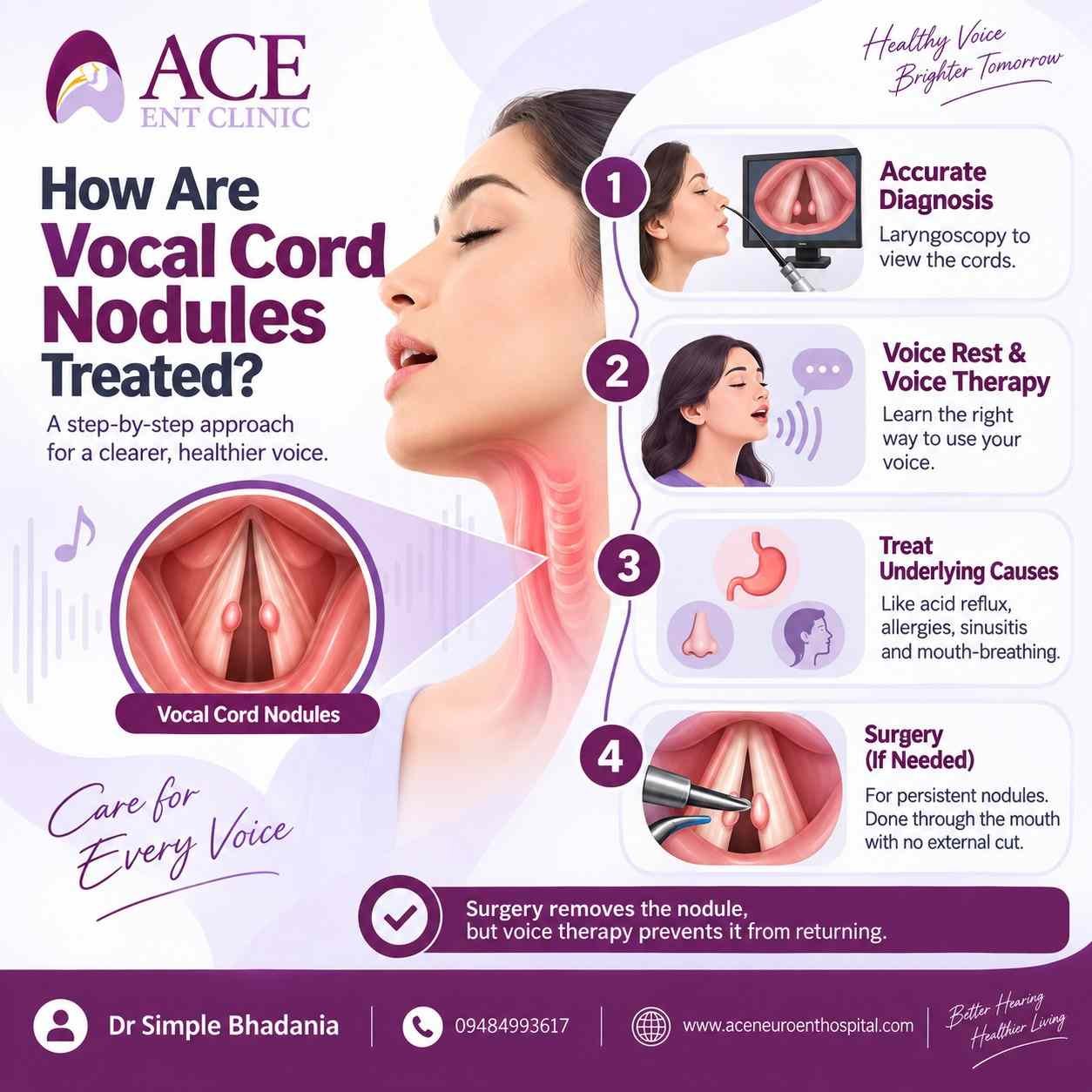
Diagnosis starts with a laryngoscopy, a thin, flexible camera passed through the nose to view the cords while you speak. A stroboscopy may be added to study how the cords vibrate.
Treatment then follows a clear order, and surgery is at the end of it, not the beginning.
Voice rest and voice therapy. This is the main treatment, and it works for most patients. A speech therapist retrains how you produce sound, breath support, pitch, projection without strain. It is not a week’s silence; it is a change in technique you keep for good.
Treating what feeds the problem. Acid reflux, allergic rhinitis, chronic sinusitis and mouth-breathing all keep the cords inflamed. Controlling these often improves the voice on its own.
Occupational changes. A clip-on microphone for classroom teaching, planned voice breaks between batches, hydration through the day, and no whispering. Whispering strains the cords more than normal speech, not less.
Micro-laryngeal surgery. Reserved for nodules that persist despite several months of proper therapy, or for firm, long-standing nodules. It is done under a microscope through the mouth, with no external cut. Recovery involves a period of voice rest afterwards, and here is the part worth being clear about: surgery removes the nodule, it does not correct the habit. Without voice therapy afterwards, nodules can return.
What Results Can You Realistically Expect?
Most patients with early nodules recover good voice quality with therapy alone over six to twelve weeks. Long-standing, firm nodules respond more slowly and are the ones more likely to need surgery.
What we do not promise is a “new” voice. The goal is a voice that lasts through your working day without pain or fatigue, and vocal cords that are not being re-injured every week. For a teacher, that usually means finishing six classes and still being able to talk to family at dinner.
Conclusion
A voice that tires by midday is not something you simply have to accept because of your profession. Vocal cord nodules are common among people who speak for a living, they are treatable, and in most cases the treatment is retraining rather than surgery. What decides the outcome is how early you act soft, early nodules respond far better than ones you have carried for two years.
Trusted ENT Specialist in Ahmedabad
If your voice has been rough for more than three weeks, you can book an appointment for a voice assessment before it becomes a longer problem.
Frequently Asked Questions
Q: Are vocal cord nodules cancerous?
A: No. Nodules are benign, non-cancerous swellings caused by friction. However, because hoarseness has several possible causes, the diagnosis should be confirmed by an ENT examination rather than assumed.
Q: Can vocal cord nodules go away on their own?
A: Early, soft nodules can improve with genuine voice rest and better technique. If the vocal demand that caused them continues unchanged, they usually persist or return.
Q: How long is voice rest after vocal cord surgery?
A: Complete voice rest is typically advised for about a week, followed by a gradual, supervised return to speaking. Your surgeon will set the exact schedule based on what was done.
Q: Will I have to change my job as a teacher or singer?
A: Almost never. Most patients continue in the same profession using amplification, scheduled voice breaks and corrected technique learned in voice therapy.
Q: Do steam inhalation and home remedies cure nodules?
A: Steam and hydration soothe irritated cords and are helpful support, but they do not remove an established nodule. They work alongside voice therapy, not instead of it.
Q: At what point should I see a doctor for hoarseness?
A: If your voice has been altered for more than two to three weeks, get it examined. Sooner if there is swallowing difficulty, a neck lump, one-sided ear pain, or if you use tobacco.
Medical disclaimer: This article is for general information only and is not a substitute for medical advice, diagnosis or treatment. Symptoms described here can arise from several different conditions. Please consult a qualified ENT specialist for advice about your own situation.