


That feeling when your ear won’t “pop” no matter how many times you yawn, swallow, or chew gum? Or the dull sense that one ear is underwater, muffling every sound around you? For many people, this isn’t wax or an infection. It’s Eustachian tube dysfunction, one of the most common reasons patients visit an ENT specialist in Ahmedabad for ear complaints that don’t involve pain or discharge.
It’s a small structure with a big job, and when it stops working properly, it can leave you dealing with pressure, popping sounds, and muffled hearing for weeks. Here’s what’s actually going on, and what helps.
What Is Eustachian Tube Dysfunction?
The Eustachian tube is a narrow passage connecting your middle ear to the back of your nose and throat. Its job is simple but essential: it equalises air pressure on either side of your eardrum and drains any fluid that collects in the middle ear. Every time you yawn, swallow, or chew, it opens briefly to let air in and reset that pressure.
Eustachian tube dysfunction (ETD) happens when this tube doesn’t open and close the way it should, usually because it’s inflamed, swollen, or partially blocked. When that happens, pressure builds up unevenly, and your ear starts sending you signals: fullness, muffled hearing, crackling, popping, or a dull ache that comes and goes.
ETD isn’t rare. Most people experience a mild version of it during a cold or a flight and never think twice about it. It becomes a concern when the symptoms stick around for weeks, keep coming back, or start affecting your hearing and daily comfort.
What Causes Eustachian Tube Dysfunction?
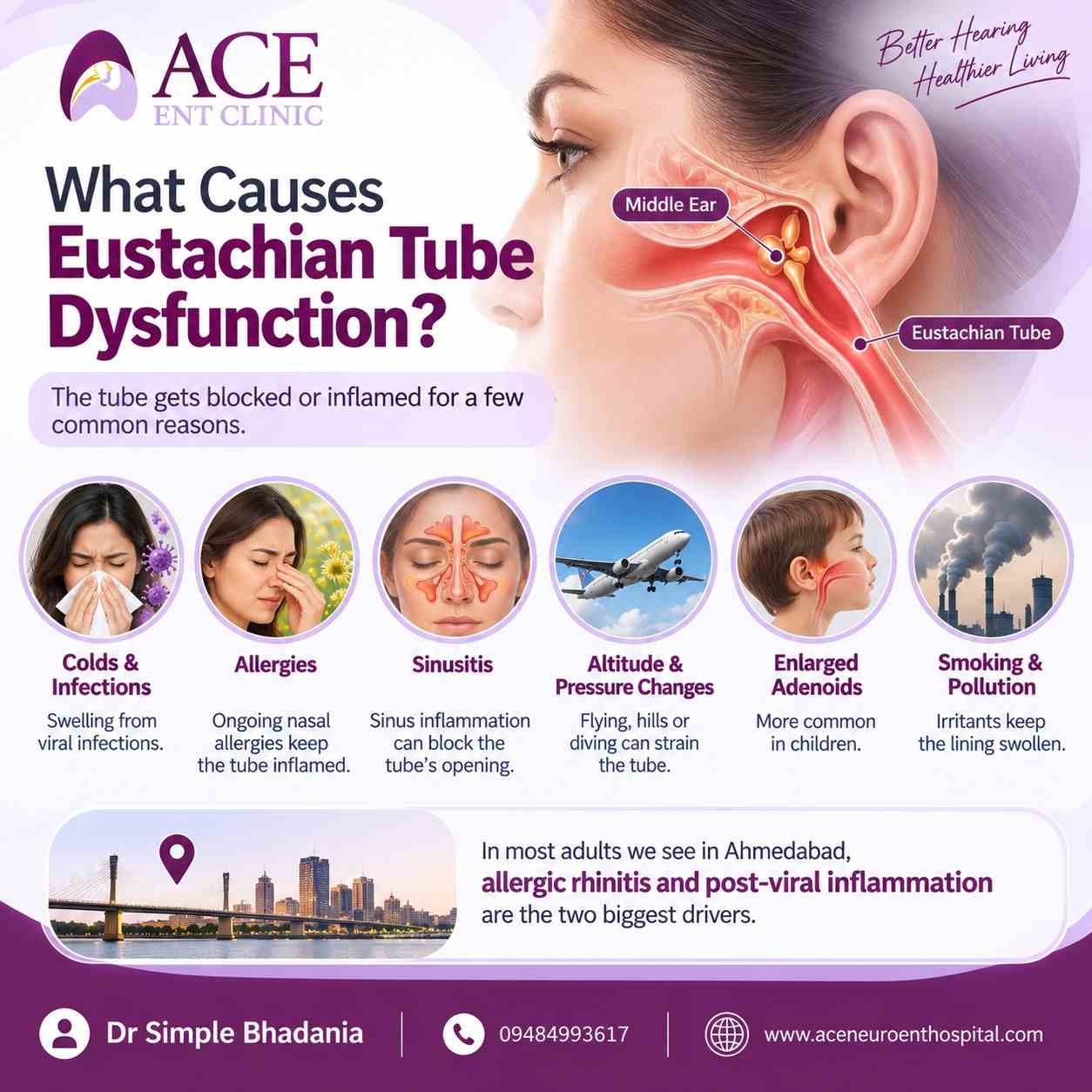
The tube gets blocked or inflamed for a handful of common reasons:
- Colds and upper respiratory infections: swelling from a viral infection is the most frequent trigger.
- Allergic rhinitis: ongoing nasal allergies keep the lining of the tube inflamed even without an active infection.
- Sinusitis: chronic sinus inflammation sits right next to the tube’s opening and can block it.
- Altitude and pressure changes: flying, driving through hills, or scuba diving can strain a tube that’s already narrow or inflamed.
- Enlarged adenoids: more common in children, where adenoid tissue physically sits near the tube’s opening.
- Smoking and pollution exposure: chronic irritants keep the lining swollen.
In most adults we see in Ahmedabad, allergic rhinitis and post-viral inflammation are the two biggest drivers, which is why symptoms often flare during seasonal changes.
How Is Eustachian Tube Dysfunction Diagnosed and Treated?
Diagnosis usually starts with a simple ear and nose examination, sometimes combined with a hearing test or tympanometry (a quick, painless test that measures how your eardrum moves in response to air pressure). This tells us whether the issue is truly the tube, or something else like fluid buildup or a Eustachian tube that’s staying too open, a different, less common condition called patulous ETD.
Treatment depends on what’s driving it:
- Mild, short-term cases (post-cold or post-flight) often settle with decongestants, saline nasal rinses, and simple techniques like the Valsalva manoeuvre (gently exhaling with your nose and mouth closed) to help the tube open.
- Allergy-driven ETD responds well to nasal steroid sprays and antihistamines that reduce the ongoing inflammation.
- Chronic or recurrent cases that don’t improve with medication may need a closer look, sometimes at the adenoids, sometimes at the sinuses, to treat the underlying cause rather than just the symptom.
- Balloon Eustachian tuboplasty is an option for select chronic cases where the tube itself is narrowed. It’s a minimally invasive procedure that gently widens the passage using a small balloon guided through the nose, done under Dr Simple Bhadania care when medical management hasn’t been enough.
Not every case needs a procedure. In fact, most don’t. The goal is always to start with the least invasive option that actually addresses the cause.
What Should You Expect?
If your ETD is mild, you can expect it to improve within one to three weeks with basic treatment. What’s worth watching for is fluid quietly building up behind the eardrum without you realising it. This can happen even without pain, and over time it can affect hearing, especially in children. That’s part of why we generally recommend an ENT check-in if symptoms last beyond two to three weeks rather than waiting it out indefinitely.
For chronic or recurrent ETD, expect a slightly longer process: identifying and treating the trigger (allergies, sinus issues, adenoids) usually matters more than any single ear treatment. Patients who address the underlying cause tend to see far fewer repeat episodes than those who only treat the ear symptoms each time they flare.
Warning Signs: When to See a Doctor
Most ETD is uncomfortable rather than dangerous, but you should get it checked if you notice:
- Ear fullness or muffled hearing lasting more than two to three weeks
- Ear pain that’s worsening rather than settling
- Fluid or discharge from the ear
- Hearing loss that doesn’t improve
- Dizziness or balance problems alongside the ear symptoms
- Recurrent episodes, three or more times in a year
Conclusion
Eustachian tube dysfunction is common, usually manageable, and rarely dangerous, but it’s also not something to keep “waiting out” for months. If your ears have felt blocked, popped, or muffled for more than a couple of weeks, it’s worth getting an actual look rather than guessing whether it’s allergies, wax, or something else. Simple treatment early on usually prevents the repeat episodes that become genuinely frustrating.
Trusted ENT Specialist in Ahmedabad
Book a consultation with Dr. Simple Bhadania at ACE Neuro ENT Hospital, Ahmedabad, and get a clear diagnosis instead of guessing.
Frequently Asked Questions
Q: Can Eustachian tube dysfunction go away on its own?
A: Yes, mild cases linked to a cold or a flight usually resolve within one to two weeks as the swelling settles. Cases linked to ongoing allergies or sinus issues tend to keep recurring until the underlying trigger is treated.
Q: Is Eustachian tube dysfunction the same as an ear infection?
A: No. ETD is a pressure and drainage problem, while an ear infection involves active bacterial or viral infection, often with pain and sometimes fever. That said, untreated ETD can make you more prone to ear infections because fluid sits trapped behind the eardrum.
Q: Why does my ear feel worse when I fly or drive in the hills?
A: Altitude changes require rapid pressure equalisation. If your tube is already inflamed or narrowed, it can’t keep up, which is why flights and hill drives often trigger noticeable fullness or pain.
Q: Can children get Eustachian tube dysfunction?
A: Yes, and it’s actually very common in children because their Eustachian tubes are shorter and more horizontal, making drainage less efficient. Enlarged adenoids are a frequent contributing factor in kids.
Q: Is balloon Eustachian tuboplasty painful or a major surgery?
A: It’s a minimally invasive, day-care procedure done under anaesthesia through the nose, with no external cuts. It’s typically reserved for chronic cases that haven’t responded to medical treatment, not a first-line option.
Q: How is Eustachian tube dysfunction different from wax blockage?
A: Wax blockage is usually a steady, one-sided fullness that a doctor can often see and clear immediately during examination. ETD involves the tube itself and often comes with popping, crackling, or symptoms that shift with swallowing or altitude, something an exam and, if needed, a tympanometry test can distinguish clearly.
This article is for informational purposes only and does not replace personalised medical advice. Please consult an ENT specialist for diagnosis and treatment specific to your condition.