

Your toddler comes running with a bead stuck in one nostril, or you notice your child tilting their head and tugging at an ear that won’t stop bothering them. Before panic sets in, here is the short version: most of these situations are treatable, they happen far more often than parents realize, and how you handle the first few minutes matters. This guide from ACE Neuro ENT Hospital, covering ear problems in children, walks you through exactly what to do, what to avoid, and when it’s time to head straight to a doctor.
Why This Happens So Often
Children between the ages of one and six are naturally curious, and their ears and nose are right there for exploring. Beads, small toy parts, food, crayon pieces, cotton bud tips, and even insects are common finds. It isn’t a sign of bad parenting or a careless moment. It’s simply a normal part of early childhood, and most pediatric ENT clinics see cases like this regularly.
The tricky part is that children, especially younger ones, don’t always tell you what happened. Sometimes the first clue is a smell, a discharge, or a child who suddenly refuses to let you near one side of their face.
Signs Something Might Be Stuck
Watch for these clues, particularly if your child can’t yet explain what’s wrong:
- One-sided nasal discharge with a foul smell (this is a strong indicator for a nose object, since infections rarely stay on just one side)
- Ear pain, tugging at the ear, or sudden irritability without fever
- A feeling of fullness or muffled hearing in one ear
- Bleeding from the ear or nose without an obvious injury
- A child who suddenly avoids one nostril while breathing, or breathes only through their mouth
What to Do for an Object in the Ear
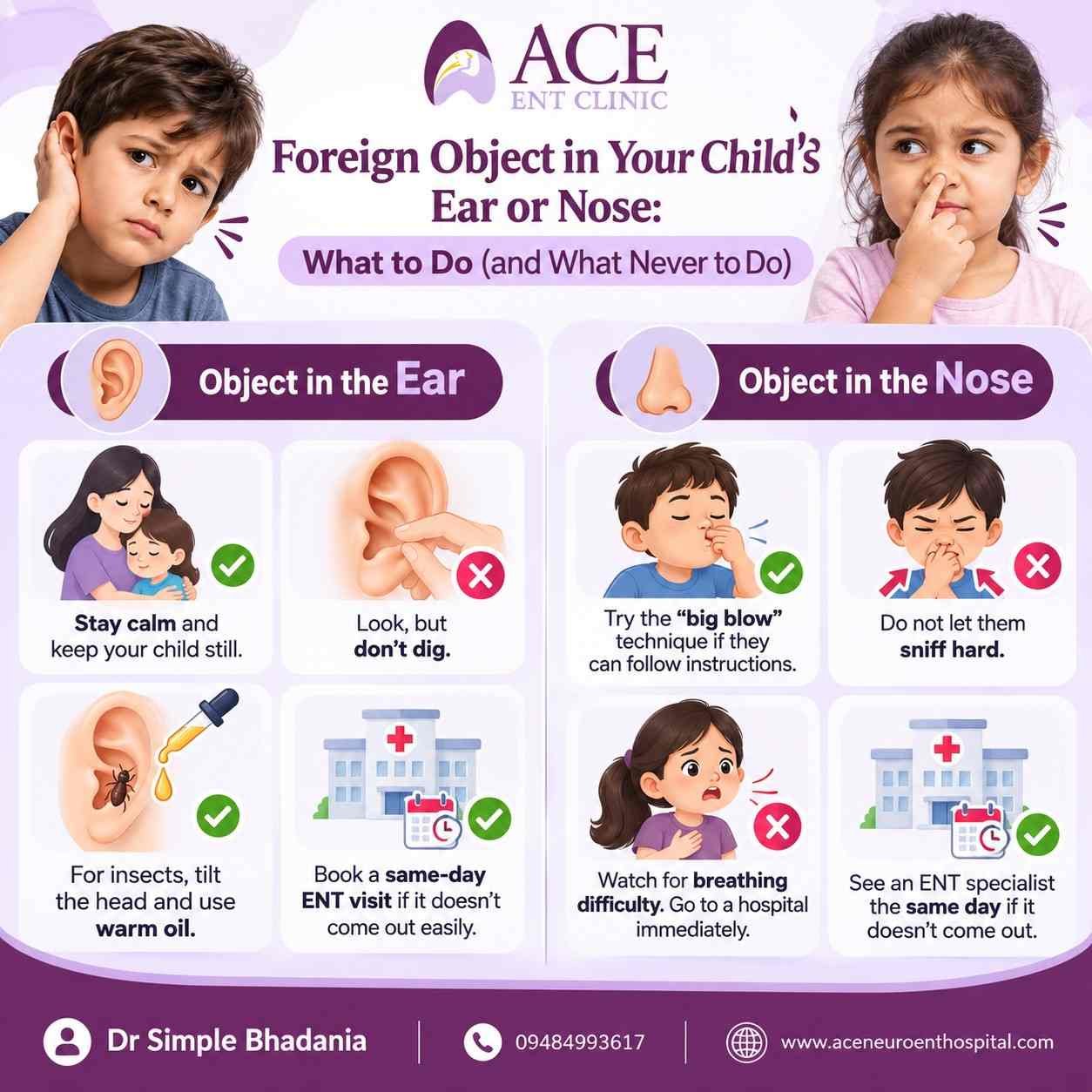
- Stay calm and keep your child still. A frightened, squirming child makes any object harder to remove safely, whether at home or at the clinic.
- Look, but don’t dig. If you can clearly see the object and it’s soft and easy to grasp with your fingers, gentle removal may be possible. If it’s lodged deeper or you’re unsure, stop there.
- Tilt the head if you suspect an insect. For a live insect in the ear, tilting the child’s head so the affected ear faces up, then gently pouring in a small amount of warm (not hot) oil, can help immobilize it before your visit. This step is specific to insects only.
- Book a same-day ENT visit if the object isn’t easily visible or doesn’t come out with a gentle attempt.
What to Do for an Object in the Nose
- Try the “big blow” technique, if your child is old enough to follow instructions. Have them close the unaffected nostril and blow firmly through the other one. This works surprisingly often for soft objects like tissue or small toy pieces.
- Do not have your child sniff hard, since this can push the object further back and closer to the airway.
- Watch for breathing difficulty. If your child seems to be struggling to breathe or the object may have moved toward the throat, this becomes urgent. Head to a hospital immediately rather than trying more home techniques.
- See an ENT specialist the same day if the “big blow” doesn’t work within a couple of attempts.
What You Should Never Do
Some well-meaning instincts can actually make things worse. Avoid these:
- Never use tweezers, cotton buds, hairpins, or any tool to reach into the ear or nose canal. These often push the object deeper or injure the delicate tissue and eardrum.
- Never try to flush out a suspected button battery with water. Batteries react with moisture and body tissue, and can cause serious burns within hours. This needs emergency treatment, not a home remedy.
- Never let a child lie flat or tilt their head back if a small round object is in the nose, since this can increase the risk of it slipping toward the airway.
- Never ignore symptoms because “it doesn’t seem to be bothering them.” Some children adapt quickly and stop mentioning discomfort even while the object remains in place, sometimes for days or weeks, quietly causing infection.
When It’s a True Emergency
Two situations call for immediate medical attention rather than a same-day appointment:
- A button battery in the ear or nose, at any point. These can cause tissue damage within two hours.
- Any sign of breathing trouble, choking, or an object that may have moved toward the throat or airway.
For anything in this category, go to the nearest emergency room without delay.
What to Expect During the ENT Visit
At ACE Neuro ENT Hospital, a foreign body visit is usually quick and far less stressful than parents expect. The doctor will examine the ear or nose using proper lighting and instruments designed for safe removal, often using suction, fine forceps, or a small hook depending on the object’s shape and position. Most objects come out in a single visit without the need for sedation. Afterward, the doctor checks for any irritation, infection, or injury to the eardrum or nasal lining, and may prescribe antibiotic drops if needed.
If your child has ongoing ear pain or discomfort even after an object has been removed elsewhere, it’s worth getting checked, since related ear pain can sometimes persist from minor injury during removal attempts.
How to Prevent It Going Forward
- Keep small objects like beads, button batteries, magnets, and coin cells well out of reach of children under six.
- Avoid giving very young children toys with small detachable parts.
- Teach children early that ears and nose are not places to put things, using simple, repeated reminders rather than one conversation.
- If your child has had repeated infections or often puts things in their ears, it may be worth a routine check for underlying tonsil or adenoid issues, since children with chronic ear troubles sometimes explore their ears more.
Conclusion
A foreign object in a child’s ear or nose is one of the most common reasons parents rush to an ENT clinic, and in almost every case, it’s far less alarming than it feels in the moment. The key things to remember are simple. Stay calm, avoid using tools at home, treat button batteries and breathing trouble as true emergencies, and don’t wait too long to get a same-day check if home attempts don’t work. With the right care, most children walk out comfortable within the same visit, and parents walk out relieved. If this happens in your home, trust your instincts, skip the DIY tools, and let a trained ENT specialist take it from there
Trusted ENT Specialist in Ahmedabad
If your child has something stuck in their ear or nose right now, don’t wait for it to resolve on its own. A quick, same-day visit is usually all it takes to remove it safely and comfortably. Book an appointment with our pediatric ENT team today.
Frequently Asked Questions
Q: My child says something is in their ear but I can’t see anything. Should I still get it checked?
A: Yes. Some objects sit deeper in the canal and aren’t visible without proper lighting and equipment. Trust your child’s report and get it examined.
Q: Is it an emergency if my child has had an object in their ear overnight?
A: Not usually an emergency in the same way a battery or breathing difficulty is, but it should still be seen the next morning. Prolonged presence increases the risk of infection.
Q: Can I use a magnet to remove a metal object from my child’s ear or nose?
A: This should only be attempted by a doctor with the right equipment. Home attempts with magnets can misjudge distance and push the object further in.
Q: Will my child need sedation for removal?
A: Most cases don’t. Sedation is typically reserved for objects that are difficult to reach or for children who are too distressed to stay still for a brief procedure.
Q: How can I tell if it’s an insect and not something else?
A: Insects often cause sudden, sharp discomfort with a buzzing or crawling sensation, sometimes visible movement. If you’re unsure, treat it the same as any other object and get it checked promptly.