

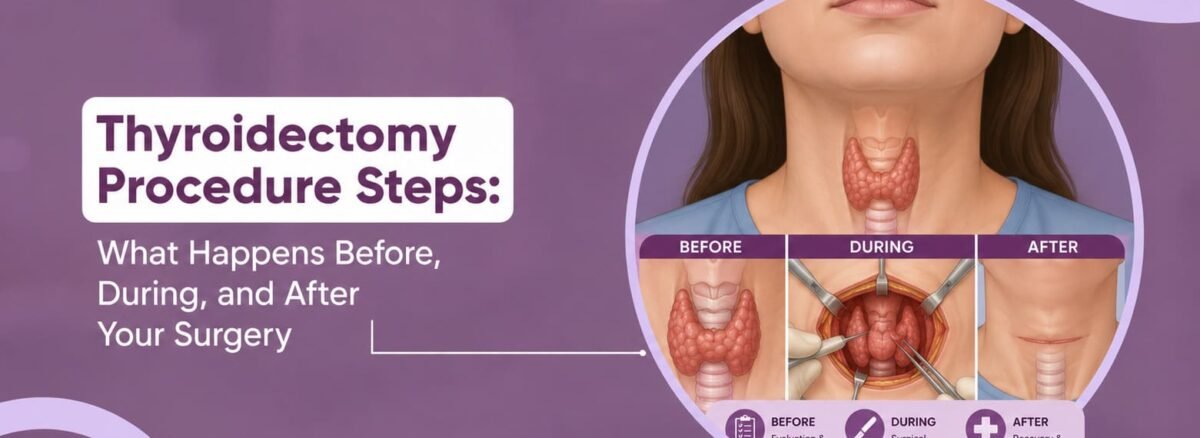
If your doctor has recommended a thyroidectomy, it is natural to feel anxious. Knowing exactly what happens at each stage can help you walk into the operating room feeling prepared rather than nervous. This guide breaks down every thyroidectomy step in plain language so you know what to expect from start to finish.
What Is a Thyroidectomy?
A thyroidectomy is a surgery to remove all or part of your thyroid gland. The thyroid is a small, butterfly-shaped gland at the front of your neck that controls your metabolism, heart rate, and energy levels.
Doctors recommend a thyroidectomy for conditions such as:
- Thyroid cancer
- Large goiter (an enlarged thyroid gland)
- Thyroid nodules that are suspicious or growing
- Hyperthyroidism that does not respond to other treatments
Types of Thyroidectomy
Depending on your condition, your surgeon may perform one of the following:
- Total thyroidectomy: The entire thyroid gland is removed. This is the most common approach for thyroid cancer and large goiters.
- Thyroid lobectomy (partial thyroidectomy): Only one lobe (half) of the thyroid is removed, often for a single nodule or early-stage cancer in one lobe.
- Near-total thyroidectomy: Almost all thyroid tissue is removed, leaving a tiny amount near the parathyroid glands to reduce the risk of complications.
The right type for you depends entirely on your diagnosis, the size of your thyroid, and your surgeon’s assessment. Always discuss the best option with your surgeon.
Step 1: Before Surgery (Preparation)
Good preparation makes surgery safer and recovery faster. Here is what happens in the days and weeks before your operation.
Pre-Surgery Tests and Assessments
Your surgical team will ask you to complete a set of tests, including:
- Blood tests to check thyroid hormone levels and overall health
- Thyroid ultrasound to map the size and location of the gland or nodule
- A laryngoscopy (vocal cord check) to assess your voice box before surgery
- ECG and chest X-ray for older patients or those with heart conditions
Medications and Fasting Instructions
Your doctor will give you specific instructions. In general:
- Stop eating or drinking anything (including water) after midnight the night before surgery
- Tell your doctor about all medicines, supplements, and blood thinners you take
- Do not smoke in the days leading up to your surgery
Step 2: During Surgery (The Procedure)
Thyroidectomy is performed under general anesthesia, meaning you will be completely asleep throughout. A typical surgery lasts between 1 and 3 hours, depending on the type and complexity.
Anesthesia and Positioning
Once you are in the operating theatre, the anesthesiologist will give you general anesthesia through an IV line. A breathing tube is then placed in your throat to keep your airway open during the procedure. Your neck will be gently extended by placing a soft support under your shoulders, giving the surgeon clear access to the thyroid gland.
Making the Incision
For a standard open thyroidectomy, the surgeon makes a small horizontal cut (about 4 to 8 cm) low on the front of your neck, in line with a natural skin crease. This placement means the scar is barely visible once healed. For minimally invasive approaches, the incision can be as small as 1.5 to 2 cm.
Accessing and Removing the Thyroid
After the incision, the surgeon carefully moves aside the strap muscles (thin muscles in your neck) to reach the thyroid. The key steps during this phase are:
- Identifying the recurrent laryngeal nerve (RLN): This nerve controls your voice box. The surgeon carefully locates and protects it throughout the operation.
- Identifying the parathyroid glands: These four tiny glands sit behind the thyroid and regulate calcium in your body. The surgeon works around them to avoid injury.
- Cutting the blood supply: The blood vessels feeding the thyroid are carefully tied off or sealed before the gland is removed.
- Removing the thyroid: The gland (or the targeted lobe) is then detached and removed from the neck.
Nerve Monitoring
Many surgeons use intraoperative nerve monitoring during total thyroidectomy. A small probe is placed near the laryngeal nerve to alert the team if it is being touched or stressed. This significantly reduces the risk of voice changes after surgery.
Lymph Node Check (For Cancer Patients)
If you have thyroid cancer, your surgeon may remove some of the nearby lymph nodes for testing. A pathologist checks them during surgery to look for cancer cells. If cancer is found in the lymph nodes, additional nodes in the neck may be removed in the same operation.
Closing the Incision
Once the thyroid is removed, the surgeon checks thoroughly for any bleeding, then closes the neck in layers. The skin is closed with fine sutures or surgical glue. In some cases, a small drain tube is placed under the skin to prevent fluid build-up. This drain is usually removed the next day.
Step 3: Choosing the Surgical Approach
Not all thyroidectomies look the same. Your surgeon will choose the most appropriate technique for your situation:
- Open thyroidectomy: The traditional approach using a 4 to 8 cm neck incision. It gives the surgeon full visibility and is widely used for large glands or cancer.
- Minimally invasive video-assisted thyroidectomy (MIVAT): A smaller incision with a tiny camera to guide the surgery.
- Scarless or remote-access thyroidectomy: The incision is made through the mouth, armpit, or chest to avoid a visible neck scar. This option is suitable for selected patients and depends on the surgeon’s expertise and available technology.
Each approach has its own advantages and considerations. The best choice depends on your specific condition, the size of your thyroid, and your surgeon’s recommendation.
Step 4: After Surgery (Recovery)
Most patients are surprised by how quickly they feel better after a thyroidectomy. Here is a clear picture of what your recovery looks like.
In the Hospital
After surgery, you will spend a few hours in the recovery area (PACU) while nurses monitor your blood pressure, oxygen levels, and temperature. Most patients stay in hospital for one night and are discharged the next morning if there are no complications.
Common Symptoms After Surgery
The following symptoms are normal and should settle within a few days:
- Mild pain or soreness at the incision site
- Sore throat from the breathing tube (usually clears within 4 to 5 days)
- Hoarse or slightly weak voice (improves in most cases within a few weeks)
- A feeling that something is stuck in your throat (this fades within about 5 days)
- Neck stiffness, which improves with gentle movement
Calcium Levels After Total Thyroidectomy
After a total thyroidectomy, your calcium level may temporarily drop because the parathyroid glands can be disturbed during surgery. Your doctor will monitor this and may prescribe calcium supplements for a few days or weeks. Watch for tingling or numbness in your hands, feet, or around your lips. These can be signs of low calcium. Report them to your doctor right away.
Thyroid Hormone Replacement
If your entire thyroid was removed, you will start taking a daily thyroid hormone tablet (such as levothyroxine) to replace what your body no longer produces. This is a lifelong medication, but it is safe, well-tolerated, and taken just once a day. Your dose will be adjusted based on blood tests done 4 to 6 weeks after surgery.
Returning to Normal Activities
Most patients recover faster than they expect. Here is a general timeline:
- Day 1 after surgery: Light movement around the house is fine. Keep your head slightly elevated with extra pillows.
- Within 1 to 2 weeks: Most patients return to desk work and everyday activities.
- 2 weeks: Avoid heavy lifting or strenuous exercise until cleared by your doctor.
- Driving: Resume once you can turn your neck comfortably without pain, usually within a week.
- Swimming: Wait at least one month to keep the incision site dry and clean.
- Full recovery: Most patients feel back to normal within 10 days.
Incision Care
Do not get the incision wet for the first 24 hours. You can shower the day after surgery. Small pieces of tape (steri-strips) over the wound will fall off on their own within 3 to 4 days. The scar typically fades well over the following months and is usually hidden in the natural skin crease of the neck.
When to Call Your Doctor After Surgery
Contact your surgeon immediately if you notice:
- Rapid, sudden swelling of the neck
- Difficulty breathing or severe shortness of breath
- Tingling or numbness in your hands, feet, or around your lips
- Fever above 38.5 degrees Celsius
- Redness, discharge, or unusual pain at the incision site
Consult a Specialist for Your Thyroid Surgery
If you or a loved one has been advised to have thyroid surgery, it is important to consult a surgeon who has specific training in thyroid and head and neck procedures. Dr. Simple Bhadania is an ENT specialist in Ahmedabad with expertise in thyroid and skull base surgery. You can learn more about the care provided at Ace Neuro ENT Hospital, Ahmedabad.
Final Thoughts
A thyroidectomy is a well-established and safe procedure. Understanding each thyroidectomy step, from pre-surgery preparation to the total thyroidectomy procedure steps and post-operative recovery, helps you feel more in control. Most patients go home within a day and are back to their routine within one to two weeks.
Every patient’s situation is unique. The total thyroidectomy procedure steps for one person may be different from another based on the size of the gland, the underlying condition, and the surgical approach chosen. Always discuss your specific case, surgical plan, and recovery expectations with your surgeon before proceeding.