

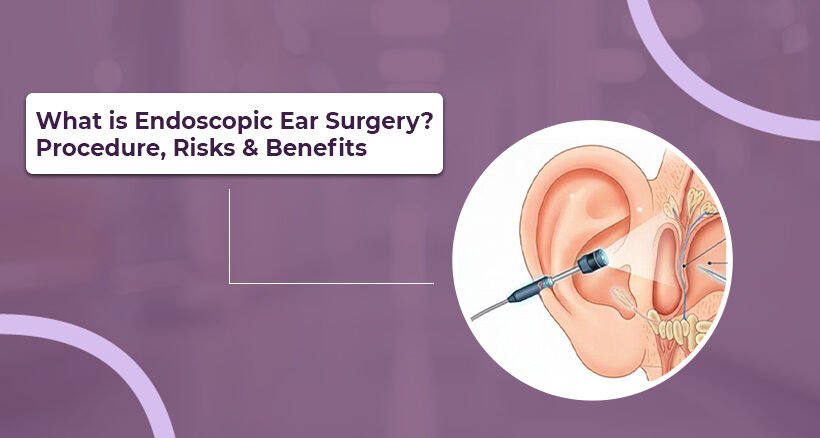
Ear problems like pain, hearing loss, or discharge should never be ignored. Modern ENT care offers advanced solutions like ear endoscopy and endoscopic ear surgery, which are safe, precise, and minimally invasive.
Endoscopic ear surgery is a procedure that uses a thin tube with a camera, which is put into the ear canal to check and fix ear problems like holes in the eardrum, long-lasting infections, and cholesteatoma. It is performed under general anaesthesia and typically allows same-day discharge with faster recovery than traditional open surgery.
What is Ear Endoscopy?
Ear endoscopy is a simple, non-invasive diagnostic procedure used to examine the ear canal and eardrum using a thin camera (endoscope).
It helps doctors clearly identify ear problems such as infections, blockages, or structural issues.
Ear endoscopy is a procedure where a small camera is inserted into the ear canal to closely examine the eardrum and inner ear for diagnosis.
How to Do Ear Endoscopy
Ear endoscopy is quick, safe, and usually done in a clinic.
Step-by-step process:
- The patient sits comfortably
- A thin endoscope with light is inserted into the ear
- The doctor views the ear on a screen
- Images may be recorded for diagnosis
Ear endoscopy is performed by gently inserting a camera-equipped tube into the ear canal. It takes 5–10 minutes and does not require anaesthesia.
Why is ear endoscopy done?
Doctors recommend ear endoscopy to diagnose:
- Ear infections (otitis media)
- Earwax (cerumen) blockage
- Eardrum perforation
- Cholesteatoma (an abnormal skin growth in the middle ear)
- Foreign objects in the ear
- Hearing loss causes
What to expect during ear endoscopy
- Usually takes 5–10 minutes
- Generally painless, though mild discomfort may occur
- You can return to normal activities immediately
Are there risks?
Ear endoscopy is considered very safe. Rare side effects may include:
- Temporary dizziness
- Mild discomfort
- Slight bleeding (if a biopsy is taken)
What is Endoscopic Ear Surgery?
While ear endoscopy is diagnostic, Endoscopic Ear Surgery is a treatment procedure.
If your doctor detects a condition that cannot be managed with medication alone, surgery may be recommended. In this approach, a surgeon uses an endoscope to operate inside the ear with high precision.
Ear Endoscopy vs Endoscopic Ear Surgery
| Feature | Ear Endoscopy | Endoscopic Ear Surgery |
| Purpose | Diagnosis | Treatment |
| Time | 5–10 minutes | 1–3 hours |
| Anaesthesia | Not required | General anaesthesia |
| Invasiveness | Non-invasive | Minimally invasive |
When is Endoscopic Ear Surgery Needed?
Endoscopic ear surgery is recommended when medications are not effective.
Common conditions requiring surgery
- Eardrum perforation – a hole or tear in the eardrum
- Chronic otitis media – long-standing middle ear infection
- Cholesteatoma – abnormal skin growth that can damage ear structures
- Otosclerosis – abnormal bone growth affecting hearing
- Middle ear bone deformities – affecting sound conduction
- Mastoiditis – infection in the mastoid bone behind the ear
- Glomus tumour – a rare vascular tumour in the ear
How is Endoscopic Ear Surgery Done?
Before surgery:
- You will undergo a pre-surgical evaluation
- Hearing tests
- You’ll receive instructions regarding fasting before surgery
- The procedure is performed under general anaesthesia
During surgery:
- A thin endoscope is inserted through the ear canal
- In some cases, a small incision may be made inside or behind the ear
- The surgeon views the internal structures on a high-definition monitor
- Specialised instruments are used to treat the condition
Because of the enhanced visualisation, surgeons can work more precisely, even in delicate areas of the middle ear.
After surgery:
- Patients are usually monitored briefly
- Most cases allow same-day discharge (daycare surgery)
- Mild discomfort may occur, but is generally manageable
- Follow-up visits are scheduled to track healing
Types of Endoscopic Ear Surgery
Depending on your condition, different types of procedures may be performed.
1. Tympanoplasty (Eardrum Repair)
Used to repair a perforated eardrum and restore hearing.
2. Ossiculoplasty
Reconstruction of tiny middle ear bones (ossicles) that help transmit sound.
Removal of abnormal skin growth to prevent further damage and complications.
4. Stapedectomy or Stapedotomy
Performed for otosclerosis to improve hearing by replacing or modifying the stapes bone.
5. Mastoidectomy
Removal of infected mastoid bone tissue to treat severe infections.
Each procedure is tailored to the patient’s specific condition and severity.
Benefits of Endoscopic Ear Surgery vs. Traditional Surgery
Patients often wonder why endoscopic techniques are preferred. The answer lies in improved comfort, precision, and recovery.
| Factor | Endoscopic Ear Surgery | Traditional Open Ear Surgery |
| Incision | Through ear canal (or small incision) | Behind the ear (larger incision) |
| Scarring | None visible | Scar behind ear |
| Anaesthesia | General | General |
| Discharge | Same day (daycare) | Usually 1–2 days |
| Recovery time | Faster — days to weeks | Weeks |
| Visibility | Better — wide-angle camera view | Limited surgical field |
| Head shaving | Not required | May be required |
| Post-op pain | Minimal | Moderate |
Key takeaway:
Endoscopic ear surgery offers a less invasive, more comfortable experience with quicker recovery in most cases.
Risks of Ear Endoscopy & Surgery
Both procedures are generally safe.
Possible risks:
- Mild dizziness
- Temporary discomfort
- Minor bleeding
- Rare hearing changes
Cost of Ear Endoscopy in India
The cost of ear endoscopy in India typically ranges from:
- ₹500 to ₹2,500 (diagnostic)
- Surgery costs vary depending on condition and hospital
When to See an ENT Specialist
If you’re unsure whether your symptoms require medical attention, it’s always better to consult an ear specialist in Ahmedabad early.
Seek medical advice if you experience:
- Persistent or severe ear pain
- Sudden hearing loss
- Continuous ear discharge
- Frequent dizziness or balance issues
- Ringing in the ears (tinnitus)
Early diagnosis through ear endoscopy can help prevent complications and determine if surgery is necessary.
Conclusion
Endoscopic Ear Surgery represents a significant advancement in ENT care, offering a safer, less invasive, and more patient-friendly alternative to traditional methods. With improved visualisation, minimal scarring, and faster recovery, it has become a preferred option for treating many ear conditions.
If you or a loved one is experiencing ongoing ear problems, don’t ignore the symptoms. Early diagnosis through ear endoscopy and timely treatment can make a meaningful difference in outcomes. Consulting an experienced ENT specialist like Dr. Simple Bhadania can help you understand your condition and choose the most appropriate treatment.